Contact us
Are you interested in the facilities or services provided at SPIC Emmen? Please contact us to see investigate the options for cooperation.

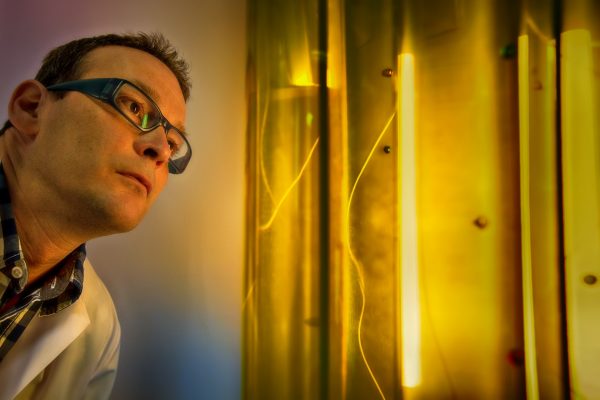
With our density gradient columns it is possible to measure the density of a polymeric sample. The principle of a Davenport density column is simple and accurate: two different organic “solvents” with different densities are mixed in such a way that a density profile over the height of the column is obtained. By applying floaters with a predefined density to the column a calibration curve can be prepared. Polymeric samples with unknown densities can now be measured.
The use of the right “solvents” is essential for a good measurement. The polymeric sample shouldn’t dissolve or swell in the “solvents”. So, in fact we need non-solvents for the specific polymeric samples. Next to that a combination of “solvents” should be found with different densities and good miscibility in a specific density range. We can measure the following polymeric samples (pellets, yarns, etc).
| Material | Density range |
| PET | 1289 – 1370 and 1330 – 1420 and 1360 – 1450 |
| Polyamide | 1030 – 1150 and 1130 – 1175 |
| Polyacrylonitrile | 1140 – 1280 |
| Aramid | 1415 – 1480 |
| PEF | |
| PLA | |
| Carbon fiber | 1500 – 2500 |
| Cellulose | 1440 – 1560 |
The preparation of a Davenport density column is laborious and time consuming. Thereafter the column can be used for several weeks to months depending on the intensity of use. After a certain time period the gradient is disturbed and a new column has to be prepared.
Semi-crystalline materials can quenched in liquid nitrogen in order to measure the amorphous density of a material.
SPIC-Emmen
Eerste Bokslootweg 17
7821 AT Emmen
The Netherlands